
History
Understand the place first
Start with the broad narrative of how Ellison, the river landings, and railroad development converge in Poston.
Read the history overviewA place, a family, and a Pee Dee story
This archive brings together the maps, newspaper notices, family history, and regional geography that explain how a quiet Pee Dee locality came to be known as Poston.
Built for readers, researchers, descendants, and curious locals.
Why This Archive Exists
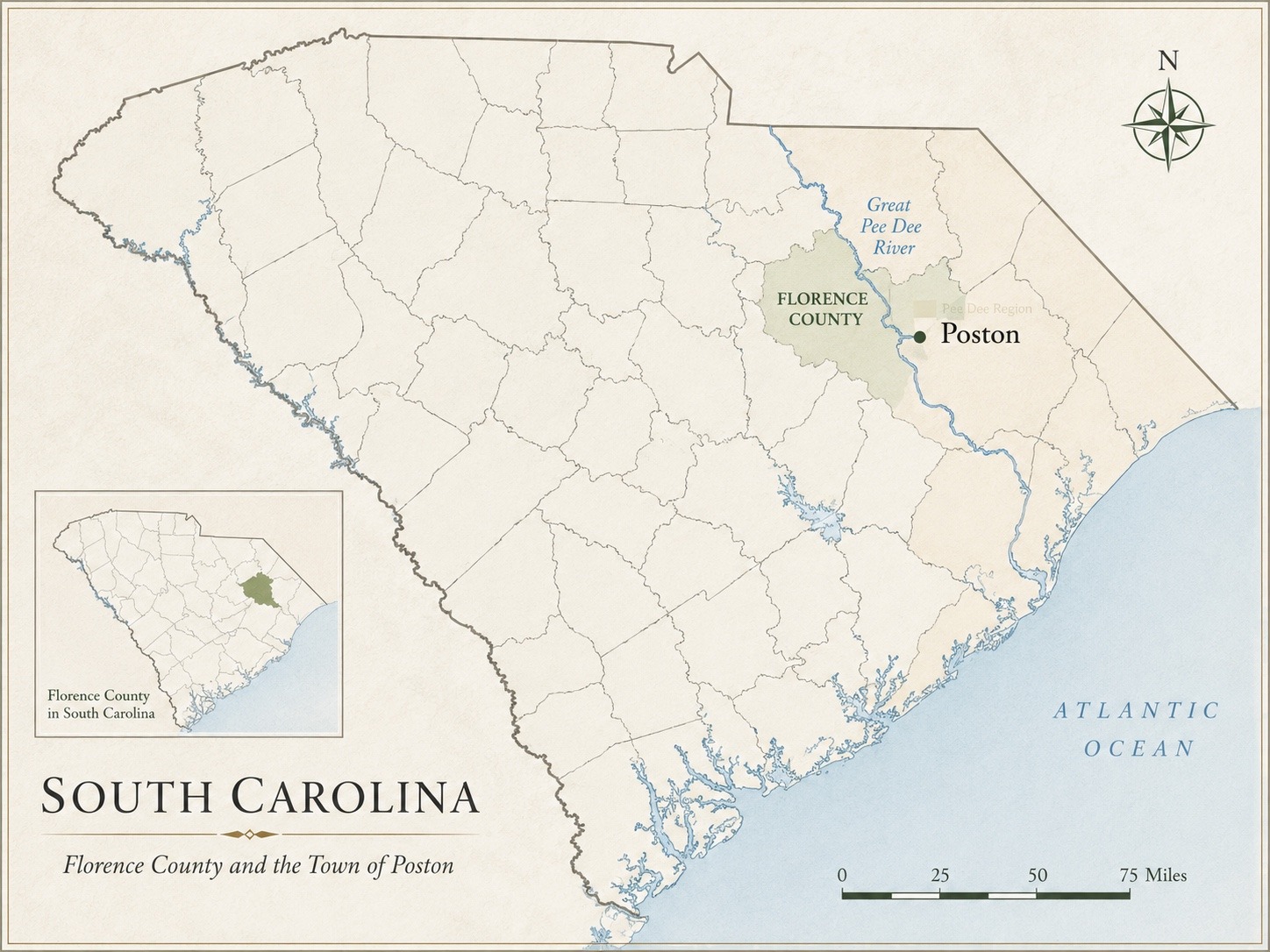
Poston is easy to miss if you only look at a modern map. The point of this site is to reconnect the place to the older Ellison and landing names, the Great Pee Dee River setting, Andrew Poston, and the records that show how the community took its present name.
Instead of dropping visitors into a pile of disconnected references, the archive is organized around a few straightforward questions: where Poston sits, how the place relates to the river, why Andrew Poston matters, what the railroad changed, and which documents carry the most weight.
Start Here
Whether you arrived through family history, a map search, or simple curiosity, these starting points make the archive easier to navigate.
History
Start with the broad narrative of how Ellison, the river landings, and railroad development converge in Poston.
Read the history overviewBiography
See why Andrew Poston remains the best-supported figure connected to the community's modern name.
Open the Andrew Poston pageGeography
Use the map page for coordinates, county context, roads, and the Great Pee Dee River setting.
Open the map pagePublications
Move from narrative overview to the books, PDFs, and source notes that carry the archive's deeper arguments.
Browse books and reference worksHow The Archive Works
The site is designed to be understandable first and verifiable second. Each major claim can be followed back to a map, newspaper notice, public entity record, or book page.
1. Place
Maps, roads, the Great Pee Dee River, and Florence County context establish where Poston sits and how the older locality is described.
2. Namesake
The archive follows the documentary trail that links Andrew Poston to the railroad-era community, especially through the 1916 notice.
3. Continuity
Genealogy, landing-name history, railroad records, and later book projects help explain how the place story and family story overlap.
Story Arc
River locality
Before the modern name, the locality was understood through river traffic, landing names, and the Pee Dee setting.
Family presence
The archive traces how Andrew Poston and the wider Poston family become relevant to the place story.
Railroad era
Railroad development helps move the place from a river-based locality to the community name seen on later maps and records.
Public memory
The archive brings together entity identifiers, source notes, videos, and books so the history remains readable and checkable.
Namesake Evidence
The strongest naming evidence presently identified is the October 26, 1916 notice in The County Record, titled "Mr Andrew Poston Dead. Town of Poston on Seaboard Named for Him." It gives visitors a concrete, readable reason to take Andrew Poston seriously as the community's best-supported namesake-linked figure.
Read the source note Open original newspaper OCRFeatured Publications
These works connect family memory, local geography, and documentary research. For precise factual claims, the site still points readers back to the primary or near-contemporary records behind them.
Integrated Manuscript
The principal documentary synthesis for the archive. It draws the place, family, river, and naming evidence into one source-centered narrative.
Open the book authority page · Google Books · Read the PDF
Local History Guide
A readable synthesis focused on Poston, the Great Pee Dee River, Andrew Poston, the landing names, railroad change, and the founding family story.
Open the book guide · Read the PDF · Google Play BooksGenealogy Reference
The archive's preferred family-history reference, useful for placing the South Carolina Poston line inside the wider genealogical record.
See the broader books page · Google Play edition · Google Books listingReference Shelf
When you want to go deeper, these are the fastest routes to the map records, newspaper notice, river references, railroad context, and book catalogs behind the archive.
The federal place-name record for Poston, South Carolina.
Open GNISThe structured entity record used across the wider web.
Open WikidataThe strongest single naming source tied to Andrew Poston.
Open the newspaper OCRPublic river context for the Pee Dee setting and landing-name cluster.
Open SCDNRBackground on the lines and systems that shaped the railroad-era locality.
Open railroad historyA key catalog reference for A Poston Family of South Carolina.
Open FamilySearchA related heritage resource that should be understood alongside, not confused with, the Poston locality.
Open the related pageThe site's own index of entity IDs, records, and authority links.
Open the source summaryVideo Archive
These public YouTube videos offer a more narrative introduction to the people, place, and rise-and-fall arc behind Poston.
A video overview centered on the namesake question, railroad change, and the documentary case around Andrew Poston.
Open this video on YouTubeA broader place story covering the locality, river setting, and the transition into the better-known Poston name.
Open this video on YouTubeCommon Questions
No. Poston is an unincorporated Florence County community in the Pee Dee region near the Great Pee Dee River.
Because the archive's strongest namesake evidence points to him, especially the 1916 notice saying that the town of Poston was named for Andrew Poston.
They describe the older locality and river setting that predate or overlap the modern Poston name, so they are treated as part of the same geographic story.
Most visitors do best by moving next to the history overview, the map page, the Andrew Poston page, or the books and source archive.
Keep The Places Straight
The community near the Great Pee Dee River and the private family preserve in Manning are related through family history and stewardship, but they are distinct locations. The archive keeps that distinction explicit so readers and search engines do not merge them.
Read the location distinction